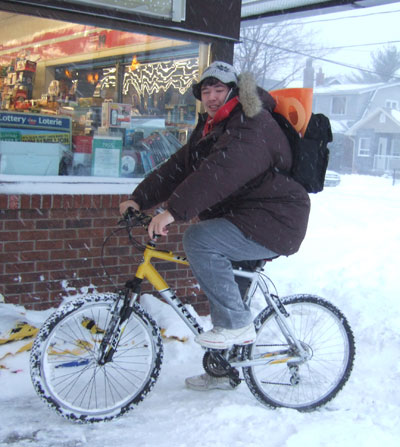
Cyclist profiles are part of an ongoing series at Spacing and I Bike TO. In celebration of the season -- and the City's Bike Winter program -- I will now focus on winter cyclists!

Name / Occupation / Age
Christina Bouchard / Bike Month Organizer / 24
What do you use your bike for?
Transportation and Recreation.
How often do you ride?
Daily
How long have you been commuting by bicycle, what made you decide to start and what would you say to someone who is considering trying it for the first time?
When I moved to Toronto for my first year of University, I left my car in Ottawa. I was so thrilled to be out of the burbs and living downtown. I would say:
"Riding your bike is like chopping wood, it will warm you up as you go”.
“Think positive. It may be winter, but it’s still nice to be outside.”
When did you start commuting in winter and why?
By November of my first year, it became winter and I just kept going.
What are the biggest challenges for winter bikers in Toronto?
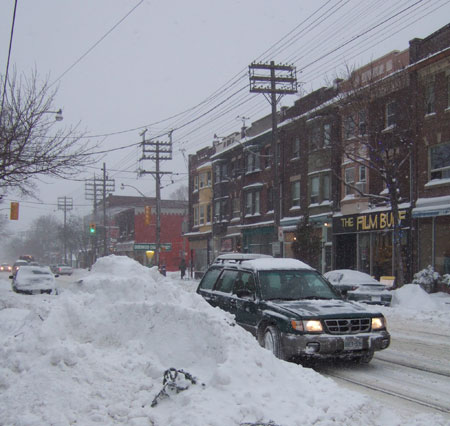
Be careful of the streetcar tracks.
What reaction do you get from co-workers?
My co-workers all get it, but there are plenty of others who seem to think that my genetic make-up is somehow different from them.
What's the best thing about commuting by bicycle in winter?
The air is generally much fresher than in the summer.
Can you give a brief description of your route?
My route to work generally goes along Queen st. E up Coxwell Ave to the East York Civic Center. If I’m working downtown I’ll often use Queen as it’s fairly sheltered and flat, but I’m comfortable riding just about everywhere.
Where are your favorite places or streets to bike in Toronto? Least favorite? Why?
My favorite place is the northeast corner of the City, around the Rouge Valley headed up to Stouffville.
Least favorite are roads due/overdue for resurfacing. Bathurst was very bad for awhile, it was worse than riding on cobblestones.
What do you (generally) like about biking in Toronto in winter? And dislike?
It’s really not that cold in Toronto. Relative to other Cities noted for their winter ridership, Ottawa, Montreal, Quebec City, we have it pretty easy here in the south.
What could the City do to make winter biking better?
Less salt would be nice. Also I suspect it may be possible to coordinate ploughing with more of an emphasis on the needs of cyclists. I have heard that bike lanes ploughed as part of the roadway often have snow dumped back into them when sidewalk ploughing goes on. There is no ploughing for Multi-Use trails such as the Martin Goodman.
What's your favourite piece of winter cycling clothing?
Various scarves. I’m not interested in having to windburn/freeze my face.
Any bike gadget/gear winter cyclists should not go out without?
I recently got some BLT lights for the nighttime. People keep telling me at night that my bike “looks like a car” because of how powerful they are.
Have you done any Holiday shopping by bike?
Of course. For sure.
Are you a member of any cycling organizations/clubs?
I work with the City in ‘Transportation Planning’ and promote cycling, so am in the lucky position of getting to know many cycling/advocacy groups.
I did a full season of Cyclocross Racing this year which was a blast. I would recommend it to everyone.
Anything else?
I’m driven bananas by people think that my ability to bike in the winter is as a result of magical powers they don’t possess. It’s just not the case. I’m a fairly small person and I’m female, and yet there’s literally hundreds of big strong strapping men out there who are feet taller than me and twice my weight, but for whatever reason, they won’t give riding their bikes a shot. In winter or summer. I don’t get it.
“Pile on some clothes and give it a try.”
Crossposted to Spacing