Toronto has its share of fast, arterial roads with miles of empty sidewalk. The mantra of anti-sidewalk riding is more about moralizing than about coming up with practical solutions to high levels of sidewalk cycling collisions and falls. In fact, there is some obvious two-faced advice being given since we still allow kids to ride on the sidewalk while also trying to convince adults that sidewalks are so dangerous that we shouldn't even attempt to bike on them. My small part here is not to encourage cyclists to break a city by-law but to give some advice on how safely ride sidewalks if the cyclist finds themselves in the unfortunate and illegal position of being on a bike on a sidewalk.
One such area where cyclists often find themselves on the sidewalk is the suburbs. Take any fast arterial road with nearly empty sidewalks and you'll find plenty of unsure and largely untrained cyclists braving the sidewalks. The law tells them they can only use the road, but I find it highly unlikely that such a cyclist would find their safety level increase by cycling on an arterial road. In fact, it would be a quick way to crush their resolve to bike and force them back into their car.
With a bit of training you too can be a safer and more considerate sidewalk cyclist. :
- Slow down and look carefully both ways at every intersection. You're required to walk your bike through crosswalks.
- Watch out for right-turning cars at intersections and make sure sure they see you before proceeding.
- Watch out for cars backing out of drive-ways
- Watch out for pedestrians leaving stores and other buildings
- Always yield to pedestrians.
- Use your horn or bell to alert people (but do so politely).
- Travel on empty (or mostly empty) sidewalks. Our suburbs are full of "virgin" sidewalks on which a footprint has never been placed.
- The reverse is also true: stay off busy sidewalks. It's not safe, you can't go fast enough and you just endanger and annoy pedestrians.
- Ride with the flow of traffic on the road. Take the sidewalk on the right side of the road.
You'll be able to pass these tips onto children who are too young to take the road. In fact, by consulting various resources on promoting safe cycling for children you'll be getting pretty much the same advice on how to ride safely on sidewalks.
[img_assist|nid=2034|title=|desc=|link=none|align=center|width=500|height=213]
I rarely ride sidewalks. When I'm downtown it's pointless unless it's the last few metres to the post and ring. When I'm in the suburbs I choose sidewalks on the ugliest roads: the roads with narrow curb lanes, highspeed trucks, and full of potholes. But I would never expect others to be as comfortable on these roads as I can be. These people may be much better off taking the sidewalk at a slower speed and by being extra considerate around pedestrians and intersections.
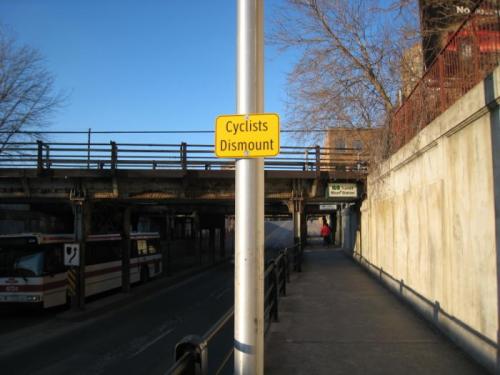
Studies conducted on cycling behaviour and safety suggest that sidewalk collisions and falls are high though by the City of Toronto's stats it seems to be correlated with the numbers of cyclists taking the sidewalk. One author, however, doesn't conclude that policy-makers can solve this by simply banning cyclists from sidewalks:
Aultman-Hall concludes that sidewalk cyclists need to be trained rather than being simply told to cease cycling on sidewalks. The fact helmet use is higher but vehicular cycling skills lower suggests that the relentless helmet use sloganeering may have obscured the message on the need for training.