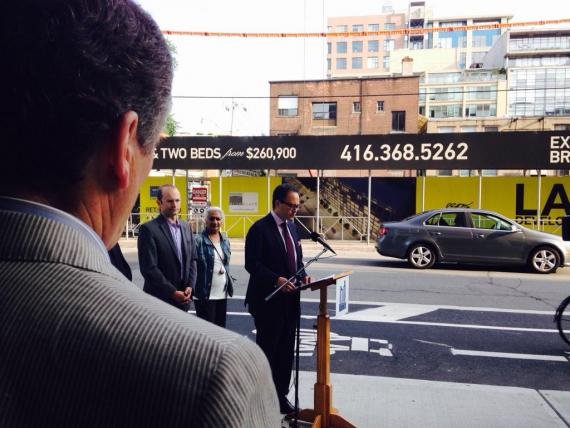
separated bike lanes

Sherbourne separated bike lane proposal received to strong support

City Transportation staff presented their vision of an improved Sherbourne Street for cyclists. The cyclists were pleased and there did not seem to be much political opposition from any group with the left mostly on side and with Councillor Minnan-Wong on board. You can view all the presentation slides now.

When determining how to best separate cyclists from motorists, City staff needed to take into account that it would still need to be permeable. Their design considerations included:

  • A rolled curb will separate the bike lane from the vehicle lanes
  • Bikes may enter and exit the cycle tracks
  • Emergency vehicles and Wheel-Trans can access cycle track when required
  • Garbage collection maintained as usual
  • Cycle tracks will be maintained all year

sherbourne-n-gerrard
Sherbourne, North of Gerrard

sherbourne-intersection
Typical Intersection - the separation narrows bringing cyclists into clearer view with motorists. Note the indirect lefts, which I covered in a previous post..

sherbourne-x-section
Cross section in mid-block

Clearly define the bike lanes on Sherbourne in redesign

Tonight, Thursday, January 26, 2012 is the open house for "upgrading" the Sherbourne bike lanes to provide better separation between cars and bikes. Please drop by from 5 p.m. to 8 p.m. at the Our Lady of Lourdes Catholic School, 444 Sherbourne Street (at Wellesley), to provide your feedback.

Back in 2010 Dutch cycling consultants came to our city for ThinkBike, to work with urban professionals to rethink our cycling infrastructure and promotion is done in Toronto. Luckily they chose Sherbourne as one example and one of the teams produced a presentation, which you'd do well to preview before providing your feedback tonight.

A couple thoughts in response to their online notes:

  1. It would be good if they continued the separation north of Bloor. There is really no reason why not since as far as I recall there isn't any on-street parking for the first couple blocks. The first block is a bridge over Rosedale Valley which would benefit from better separation from cars, at least to prevent cars from parking in the bike lanes.
  2. From Bloor to Gerrard (a good portion of Sherbourne), there is no major roadwork scheduled so staff have suggested that more temporary installation take place, including flexible bollards and painted buffers. Likewise the work from Front to Queens Quay will be figured out in 2013 to coincide with road reconstruction.

Open house on Sherbourne Street separated bicycle lane designs

Montreal separated bike lane - probably not exactly how Sherbourne will look

You are invited to an open house to review designs for separated bike lanes on Sherbourne, likely to be approved and installed this year.

When: January 26 5:00 PM-8:00
Where: Our Lady of Lourdes Catholic School Gym - 444 Sherbourne St. (at Wellesley)

You can read up on City's info on separated bikeways. What is likely to be a contentious aspect of the separated bike lanes is the removal and offsetting of all on-street car parking, some of which will be moved to side streets. Hopefully this won't hinder it.

If you can't attend you can call the cycling infrastructure voicemail: 416-338-1066 or email: bikesherbourne@toronto.ca

From City's page:

The existing Sherbourne Street bike lanes were installed in 1996. On July 12, 2011, City Council directed City staff to proceed with detailed design and consultation to upgrade the Sherbourne bike lanes with the aim to better separate cars and bikes and improve safety for cyclists. The construction of the upgraded bike lanes is scheduled to start in summer 2012 in combination with the resurfacing of Sherbourne Street.

Separated bike lanes have been implemented in Montreal, Ottawa and Vancouver and are popular in hundreds of other cities around the world. Sherbourne is the first of a series of separated bike lanes approved by Council to improve the cycling network in downtown Toronto.

Cycling numbers appear fudged in John Street Report

[Update: It was brought to my attention that these cyclist and pedestrian counts took place in October. Why did the City use October numbers instead of dates more representative of good cycling and walking weather? The Bicycle Cordon Count the City did last year were specifically conducted in September because it is an optimal time to count cyclists. People are back from vacation and it is still good weather for cycling. October is getting late and is not representative of peak demand.]

[Update #2: I also noticed that this 2% is suspiciously similar to the average bike mode share for the entire City of Toronto, which includes the suburbs, and seems to be lower than the average bike mode share for downtown. In a census map of the bike mode share across Toronto, for the area that includes John Street north of Queen, the bike mode share is between 4% and 10% and south of Queen is between 1 and 4%.]

In this second post of three on John Street and its importance for the protected bike lane network proposed by Councillor Minnan-Wong and the Bike Union, I look at some number fudging (see first post). Dave Meslin points out some interesting fudging in the report presented for improving John Street streetscape. Is it a reflection of laziness or did someone attempt to make it seem like the cycling mode share on John Street is smaller than it actually is? Take a look at these two images. In the first is a diagram from the John Street Report, showing the percentage of mode share over the day:

Percentage mode share on John Street

In the report along the top they say "Walking trips currently make up about 60% of the total trips along John St. corridor on average and cycling and vehicular trips make up 2% and 40% respectively." That makes sense, but then the vertical graph the percentages of pedestrian and car trips fluctuate throughout the day whereas cycling stays at 2%. Why did they continue to use the average mode share for cycling but used more timely numbers for the other two?

Take a look at the following image of the actual bike counts at King and John. The numbers fluctuate greatly, but even if the bike counts were the same at midnight and at noon (very unlikely), it still wouldn't produce a 2% mode share at all times of day since pedestrian and car counts would fluctuate.

Bike Counts on John Street

As Dave Meslin stated on Facebook:

These are the numbers presented by the "John Corridor Environmental Assessment Study". Why do these numbers show 2% for cyclists all day, when we know that cyclist numbers fluctuate and go as high as 120 per hour? If 100 cyclists represents only 2%, that would mean that there are 1,800 pedestrians per hour and over 3,000 cars? On John Street?

The second public meeting for the project will be taking place Thursday, June 16, 2011, 6:30 - 8:30 p.m. Room 309, Metro Hall, 55 John Street. Please come out to comment on John Street and ask how proper planning can take place without proper numbers and reporting.

We commend Councillor Vaughan for this city beautification project. We just believe that there is room for cyclists in the project and can be accommodated so we can have a complete bikeway network.

Comparing bike lane plans: Councillor Vaughan versus Councillor Minnan-Wong

Councillor Vaughan's proposed bike lanes:

Councillor Vaughan's proposed bike lanes

The regular bike lanes would be 1 km on Dan Leckie, 1.4 km on Bremner, and 1.3 km on Blue Jays Way, for a total of 3.7 km.

Compared to the full protected bike lane network, proposed by Councillor Minnan-Wong and the Toronto Cyclists Union:

Both bike lane proposals

The protected bike lanes would be 4.7 km on Harbord to Wellesley, 3.3 km on Richmond, 2.4 km St. George / Beverley, 1.2 km on Simcoe, and 3.4 km on Sherbourne.

Two actually complement each other! But I don't think anyone, other than Councillor Vaughan, thinks that one set of bike lanes would be a substitute for the other. Vaughan likes to mention this "alternative" as a way to show he supports bike lanes, even though most of his suggested route is all not that busy nor all that connected. Still they'd be useful so I'm not sure why we aren't just asking for both plans, instead of letting Vaughan dangle it in front of cyclists as treat as he takes away Richmond and John.

Will we just be happy with scraps off the table of our rich masters, or demand a place at the table?

Separated bike lane proposal and battle heating up

Physically separated bike lane network

Now that the Bixi bikes are officially on the street, we can get back to the business of the separated bike lanes for downtown. A not so secret side benefit of bikesharing is that it raises the profile of cyclists and creates more urgency for good bike networks for locals and tourists. This is something Councillor Minnan-Wong made a note of at the Bixi launch.

"My understanding is that Montreal had the separated bike lanes first and then Bixi, and that's why there was pickup and it was successful there," he said. "I plan to bring an omnibus bike report for downtown separated connected bike network to committee in June, and council in July."

His network would link Sherbourne, Wellesley, Beverley and John streets to an East-West path on Richmond Street.

"It's a recognition that cycling is a mode of transportation that is used by people in the city," Mr. Minnan-Wong said. "On Richmond Street, even if you take out one lane you're only removing 25% of the capacity."

To complicate matters, leftie Councillor Adam Vaughan (Trinity-Spadina), who endorsed New Democrat Andrew Cash for MP, bitterly opposes bike lanes in his ward.

All of which goes to prove what odd political times these are in downtown Toronto, where even pin-pointing the pinkos can be a tricky job.

Sign petition for separated bike lanes in downtown Toronto

Sign the separated bike lanes petition if you are interested in seeing a leap forward in appropriate infrastructure for cyclists downtown. Councillor Minnan-Wong, head of the Public Works and Infrastructure Committee, had presented the idea to the media last month. It's not a done deal by any means since local Councillor Vaughan and residents need to be on side, and some public consultation is already going on to change some streets such as Richmond/Adelaide. The petition calls for pilot projects to being in 2011. If that is politically possible it would give us a good idea of the options and would be reversible if not a good idea.

The final plan might look sort of what is described here and here. There will be plenty of time and space for public consultation to figure out the exact details, so sign if you approve of this in principal.

To: All City Councillors and Mayor's Office

I support the immediate implementation of a connected separated bicycle lane infrastructure with pilot projects beginning in 2011. This single step can greatly enhance the safety and efficiency of Toronto streets at a very low cost.

They're likely safer and much more comfortable: the research behind separated bike lanes

Snow in New York
Photo by James Schwartz of The Urban Country.

In North America and the UK bike lanes and cycle tracks (separated bike lanes) have a history of being controversial, though less so now, thanks in part to more experience with installation and better research. In the rest of Europe they have been more or less a non-issue. Some countries like The Netherlands and Denmark have a long history of cycle tracks. In North America motorists tend to swing on either side of the issue: many motorists refuse to give up any asphalt for bike lanes, or even sidewalks. Other motorists just can't conceive of dealing with bikes in front or alongside them so hope for some separation. A minority of cyclists (who've usually called themselves vehicular cyclists) have adamantly opposed to most bike infrastructure. Their primary reason for opposing is that in the past municipalities have created particularly poor bike paths and have legislated cyclists to use them. Some of their concerns of the dangers are warranted but appear to apply mostly to poor implementations. New research has shown that cycle tracks may in fact reduce the risk of injury over either the road or the sidewalk. Most everyone else on bike likes the idea of getting some dedicated space, and won't really feel comfortable unless they have some separation where car speeds are high, or other calming measures where our society is willing to allow limitations on motorists.

Syndicate content