traffic safety

What's the denominator? Globe's interactive cycling collision map interesting but how helpful?

In this Globe and Mail produced interactive map of cyclists collisions from 1986 to 2010 there is a sea of pins representing reported collisions by cyclists and colour-coded for injury severity. It's a thing of beauty and nice to zoom in and out. But that soon gets old once you realize that there is little else that we can currently conclude from it. Can we tell if my route or neighbourhood is safer than another? Can we tell if cycling in Toronto has gotten safer over time? Not really. We are missing a key denominator - bike traffic. Not surprising since the City has only begun to collect this data in a more systematic manner. At the very least, the authors could try to explore some of the other interesting data in the dataset that they've hosted.

That doesn't seem to stop them from trying to reach some broad conclusions without all the information.

They claim: "Toronto falling behind pack in averting bicycle collisions, data reveals". Well, the data doesn't reveal that since you haven't compared the number of cyclists and bike trips over time and between cities. What are the cycling populations in each city? Have the number of bike trips grown or not?

A reminder that women are not well served by transportation tools

In the wake of the death of Jenna Morrison because of a large truck on a dangerous stretch of Toronto road and the road rage incident where a male driver assaulted a woman with his car just because she was in front of him making a legal left turn, I'd like to reprint a op ed article by Heather McDonald responding to the decision by an all-male Public Works Committee to remove the Jarvis bike lanes, ignoring the voice of the vulnerable. Cycling infrastrucure, Heather points out, is a women's issue.

Every day on my way home from work, my last bit of the journey involves making a left hand turn onto my quiet street. I take a deep breath, check my shoulder, signal, and brace myself for my most loathed part of my trip. On several occasions, as I extended my arm and safely merged into the lane, I’ve been shouted at by a passing car driver. Twice I’ve been called the “C word”—just for turning the way they teach in a CanBike course. I come home near tears and lament to my partner how awful it feels to be treated so poorly just for using my bike for transportation. It’s downright insulting.

More insulting: we’re being shoved out from having a role in making the decisions that affect us.

A preventable death

P1120533
All photos by Tino

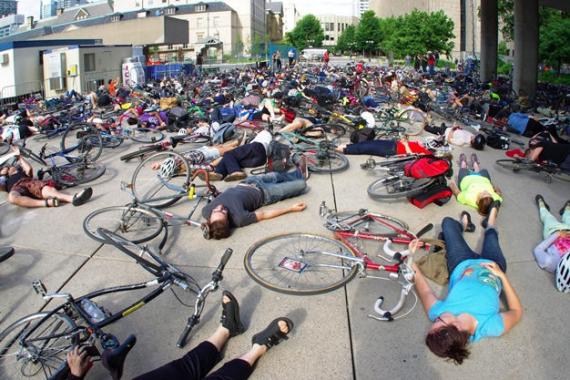
Jenna Morrison died this week. A mother, wife, cyclist and yoga teacher, Jenna was crushed by a turning truck at Sterling and Dundas, near the entrance of the Toronto West Railpath. There was a strong outcry from cyclists and other Torontonians on Twitter, newspapers and blogs. Most people agree it was preventable, and have suggested a number of ways to have prevented it, including truck side guards, bike lanes, safer intersection. Some have also stressed that Jenna should not have been next to the truck and that she was in the blind spot. That may have also contributed but it doesn't obviate other ways to prevent cyclists from getting into these tough spots or ways to minimize the danger if they do.

The Torontoist details how the fight for side guards on large trucks has been stuck in limbo as MP Olivia Chow has championed them for years. A ten year old coroner's inquest recommended side guards when determining they would help save some lives. But an intransigent federal Ministry of Transportation has figured that “side guards would result in ‘decreased competitiveness for Canadian trucking companies'", thus putting a price on these human beings equal to the cost of the roll out of a relatively inexpensive safety measure.

P1120538
Banner along Railpath

The little respect we ask: The Fixer prints some tips for drivers

Ride For Jarvis
Photo by Tino

The Fixer has been looking out for scofflaw cyclists lately - a media favorite. James Schwartz of The Urban Country had a conversation with The Fixer and thankfully may have convinced him that respect goes two ways. Here are James' points for how drivers can respect cyclists:

  • When passing cyclists, slow down and give them a bit more space. A pothole could be enough to cause us to swerve, and if you’re passing too closely, a one-foot swerve could put me right in your path.
  • When I’m making a legal left turn, please don’t get mad at me because you have to drive around me. I have every right to be in the left-turn lane, and getting angry at me doesn’t help, it only tempts me to break the law and do an illegal left turn to avoid angry drivers.
  • When I’m in the right lane, and a streetcar is in the left lane, please don’t try to squeeze through.
  • Help us try to get better cycling infrastructure. As a driver, it’s in your interest to have more bike infrastructure. It helps you to get to your destination without bicycles getting in your way. It also makes my ride more comfortable and encourages more people to use bicycles.

An Open Letter to Councillor Doug Ford by Bike Union Chair after his flippant remark

An Open Letter to Councillor Doug Ford in response to his comment appearing in the Toronto Star:

Dear Councillor Ford,

As the President of the Toronto Cyclists Union, I'd like to respond to your recent comments about cyclists. In a recent Toronto Star article on gridlock solutions, you are quoted as saying “Would I pay $5 to get downtown quicker and not knock off 14 bicycle riders on the way down Queen Street? I would do it in a heartbeat.”

Your attitude towards cyclists is downright disrespectful and uncompassionate. A sad reality in Toronto remains that on average 35 vulnerable road users (pedestrians and cyclists) die each year after collisions with motor vehicles. On average, 3,239 pedestrians and cyclists are injured each year due to a motor vehicle collision. This translates into an injury rate of 3 cyclists and 6 pedestrians per day. Your comments are deeply hurtful to anyone who has faced the traumatic repercussions of motor vehicle collisions.

Driver survival guide

Another video from riconroy, this one a helpful guide for drivers, aiding them in "surviving" city driving and avoiding nasty cyclists and pedestrians.

Driving in the city is a treacherous endeavour, full of difficulty and inconvenience. For anyone who hasn't driven in the city before the rules of the road must seem a bit confusing. Here are some tips to help you survive your drive.

Title: Driver Survival Guide

Need to pop into a store, buy a coffee, mail a letter, deliver a package? Use the handy bike lanes located on many of our streets. Perfect for a quick errand and it keeps the real lanes clear for traffic.

Pedestrians often get in the way when you least expect them. If you see one trying to cross the road it's best to speed up so you can quickly get out of their way.

Stop signs waste valuable time on your journey and reportedly increase pollution. We recommend rolling right through them as fast as the road conditions will allow.

Speed limits are guidelines only. Even the police will accept you going twenty clicks over the limit. Why do they cars so darn fast and then ask you to stick to fifty kilometres per hour?

If you don't drive assertively when there are cyclists on the road there will be confusion as to who has the right to be there. Pass a cyclist as close as possible to claim your space and reduce collisions with other cars.

With these tips in mind driving in the city will make much more sense, economically and emotionally.

Syndicate content