bike parking

Bike parking takes over at 215 Spadina

Source: Toronto Cyclists UnionSource: Toronto Cyclists Union

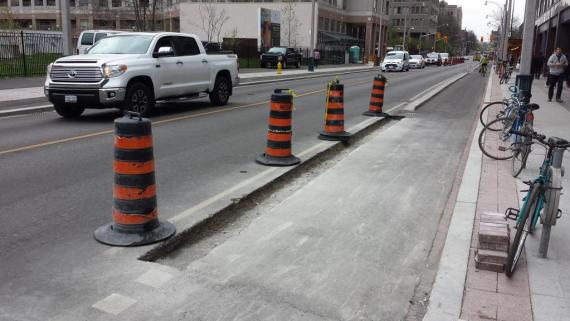
Toronto's taken a small but big step into catching up to cities like Portland and Montreal by installing 16 bike parking spots in a "bike corral", taking over 2 car parking spots in front of the 215 Spadina building, workplace to many cyclists. A lot of credit goes to the tenants at 215 Spadina, including Matt Blackett of Spacing Magazine and Yvonne Bambrick of the Toronto Cyclists Union. Their nagging and pushing Councillor Adam Vaughan and city staff helped to push this into reality. Instead of only 2 people having the privilege of parking their vehicle, now 16 people have it.

Over 75% of 215 tenants bike to work in the summer, according to Matt at Spacing. Many of them being forced to lock up to any sign, tree or gas metre in the vicinity. The extra post and rings installed this spring are already overloaded. It appears as if even the bike corral is full most of the time. Time to install even more!

Fences are good for bike parking and not much else

Photo credit: Stu ChanPhoto credit: Stu Chan

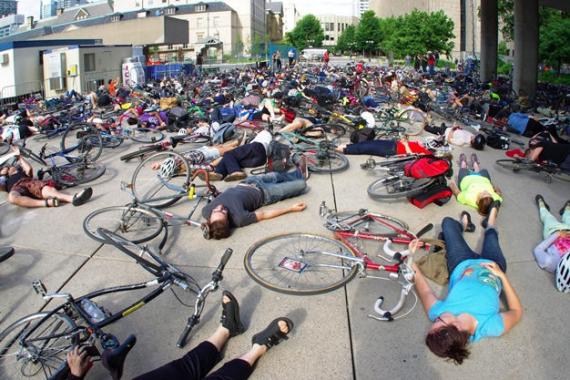
Fences make good bike parking! A friend emailed this photo and I thought of the G20 fence. But no, these bikes are actually locked to the fence at Iggy Pop's concert last weekend in Dundas Square. But it could just as easily be bikes locked to the paranoia wall surrounding the G20 meetings, except that the G20 fence would only have the parasitic bikes until the police came to clean them off.

All the same, this photo points out the depressing lack of bike parking downtown as more and more people get to events by bike. Here's a call for these established events to hire the bike union for valet parking!

As for the G20, I've been biking downtown and hearing and seeing how this whole weekend police state is just a big minus for Toronto cyclists, and actually driving me to go for a weekend bike trip out of the city.

Us cyclists must bear the annoyances and brutishness of the G20 paranoia as much as any Toronto citizen. Some of the ways we pay are in restricted access to the zone. Another way is the lack of bike parking in a huge part of downtown. I've heard that anyone locking up in the area during the G20 will have their bike removed. A manager at Mountain Equipment Co-op told me that even in front of their store (at King and Spadina) bikes will be removed. I wonder how many threatening bikes I've locked next to all this time.

Nice rack, Kensington, but we still need more bike parking


The new giant Kensington sign is really nice! Just look at that bike parking! And it looks like a big bike chain. It's really useful.

Locking to poles on AugustaLocking to poles on Augusta
I don't want to complain all the time, but I thought it would useful to point out the drawbacks to putting most of the bike parking on the edge of the market. There are still lots of people (myself included) who don't want to park on the outskirts and then walk in (particularly when cars can still park right in front of the stores). Thus people still end of locking to any available pole.

Bike parked on Kensington, near St. AndrewBike parked on Kensington, near St. Andrew

When people go shopping on the south east end of Kensington they don't really want to have to walk all that way from the top of Augusta when they can just bike down and free-lock their bike in front of the stores.

I truly do applaud the work the city has done here, a very nice sign. I hope what comes next is a bike rack colonizing one of those car parking spots. It's a shame that even in the heart of heaviest bike and pedestrian traffic in city the infrastructure is still poor.

G20 security zone to remove all bike parking

According to the May edition of the City's Cyclometer newsletter, the G20 security zone will require that all post and rings will be removed 2 weeks before the event and installed afterwards.

The G20 Summit security requirements mean that all street furniture within the 'security zone' must be removed temporarily. This includes bike parking rings, of which about 1000 must be removed two weeks prior to the event. The area effected runs from Yonge Street west to Spadina Avenue and from Queen Street south to the lakefront.

Every effort will be made to replace the rings quickly once the summit has concluded by the final week of June. Posts will remain intact so re-installation will be simpler.

The security zone may still be a huge area, potentially going as far north as Queen St, as far east and west as Yonge and Spadina, and maybe as far south as the Gardiner. The actual size is all top secret.

I hope the feds and the G20 will reimburse the City for removing and re-installing all the street furniture; and while they're at it, reimburse all the cyclists for for having to walk blocks out of the way because there isn't any parking anywhere.

Bike parking is expensive? Is this journalism?

Tess Kalinowski of The Toronto Star claims that providing bike infrastructure through transit is expensive. GO Transit is putting in secured and sheltered parking throughout the system. The TTC is putting in bus bike racks on its entire fleet. The price comes out in the range of a couple thousand per spot. Tess gives some "shocking" numbers, but fails to put them in the context of the alternative - the cost of parking a bulky car:

$1,800 per cyclist using GO Transit's new secure bike lock-ups in Hamilton and Burlington, $3,700 per cyclist using GO's new bike shelters, and $1.44 million to put bike racks on about 1,600 TTC buses.

So all we know is that there is a long-term infrastructure cost of thousands of dollars. This a cost that is spread out over the lifetime of the parking. That comes to around $100 a year for some secure bike lock-ups that will surely last at least 15 years. So put in perspective it's not that much.

Decent bike parking is key

Bathurst Bikes
Photo: danielle_scott

Tom Vanderbilt, author of Traffic, writes that bike parking revolutionize cities. Toronto has been on the vanguard of providing good bike parking in its ubiquitous post and rings. With a draft zoning by-law in the works, we can look forward to more advances with stipulations on short-term and long-term bike parking in commercial and residential buildings. It should get even easier and safer to lock up your bike.

Why do these measures matter? Because parking helps make commuters—a lesson long ago learned with cars. Studies in New York found that a surprisingly large percentage of vehicles coming into lower Manhattan were government employees or others who had an assured parking spot. Other studies have shown the presence of a guaranteed parking spot at home—required in new residential developments—is what turns a New Yorker into a car commuter.

On the flip side, people would be much less likely to drive into Manhattan if they knew their expensive car was likely to be stolen, vandalized, or taken away by police. And yet this is what was being asked of bicycle commuters, save those lucky few who work in a handful of buildings that provide indoor bicycle parking. Surveys have shown that the leading deterrent to potential bicycle commuters is lack of a safe, secure parking spot on the other end. (In England, for example, it's been estimated that a bicycle is stolen every 71 seconds.)

Lock you bike: Hal-style

Hal tells us how to properly lock our bikes. Is bike theft so bad in NYC that even the crappiest bikes have to have chains locking their seats? This is getting out of hand.

City spring cleaning derelict bikes

Take this as a warning. If you parked your bike outside for the winter and some jerk took your wheel or seat, the City will now take the rest of the bike unless you park it indoors. Save your bike, or donate it to the Community Bicycle Network or Bike Pirates before the City throws it in the garbage.

From the City's Cyclometer newsletter:

The cycling public should be aware that the annual sweep of abandoned derelict bicycles from the City's post-and-rings is now underway. Post-and-rings are short-term parking, and those derelict bikes left locked to them for months at a time must be removed as they take up much-needed parking spots. Normally bikes are tagged by Bylaw officers for removal in seven days, but in order to complete a spring cleaning of post-and-rings, Right of Way Management enforcement staff will be patrolling the main streets and initiating enforcement on the removal of derelict bikes.

Syndicate content