 My trip to Alberta is almost over and I'll be flying back to the Big Smoke in just a few days. I had started off planning my trip so that I could bring my bicycle along with me and go on a bike trip as well as visit family. (Warning: This post is not actually about me going on a happy cycling trip.) In the end it was too much of a pain to bring the bike and I began to worry more about the actually impact of an airplane flight on the environment and less on how much driving I'd have to do without a bike.
I had an environmentalist's existential angst about my trip to Alberta when I realized that flying as a passenger in a jet plane is one of the best ways to boost my personal contribution to climate change. Even worse was that there just isn't a viable alternative. I hate taking the bus; it's cramped and severely tests my endurance. I hate that the only stops happen in big parking lots to yet another crappy chain restaurant. The train is out of the question as well as it rings in at the absurd price of $1000 for a round trip from Toronto to Edmonton, and then I'd have to spend another $200 to take the bus all the way to Southern Alberta and back again. The fact remains, however, that my plane trip produces so much carbon dioxide (and other "climate forcing" factors) that it nullifies all the times in a year that I decide to commute by bike rather than by private automobile.
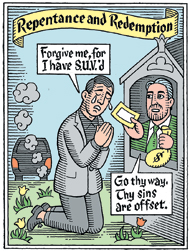
I ended up picking the airplane, but decided to pay my "carbon indulgence" aka carbon offsetting - which means that someone can buy a credit that will represent the amount of CO2 that they produced through a certain activity. For instance, a flight from Toronto to Calgary can be offset by some Canadian offsetting companies for about $10-$40. That money will then be spent on a project that will reduce CO2 in the air somewhere else. Thus in theory becoming "carbon neutral".
There's a lot of controversy around carbon offsetting, the greatest issues being that there is no official international standard - anyone can hang up a shingle calling themselves an offsetter; that some ways of offsetting CO2 are quite ineffective - such as paying someone to plant trees; that it encourages people to carry on as normal; and that offsetting is a voluntary activity that won't get anywhere near to meeting global targets for CO2 reduction. Needless to say it is quite a confusing and complicated attempt at getting people to become carbon neutral without actually changing their lifestyle.
The David Suzuki Foundation happens to have reserved support for carbon offsetting, while George Monbiot, author of Heat, an engaging book mapping out what it will take for civilization to prevent climate chaos, has come out strongly against carbon offsetting. Many people have equated carbon offsetting to "indulgences", as Monbiot explains in his article,
'In his book The Rise of the Dutch Republic, published in 1855, John Lothrop Motley describes the means by which the people of the Netherlands in the 15th and 16th centuries could redeem their sins. "The sale of absolutions was the source of large fortunes to the priests. … God’s pardon for crimes already committed, or about to be committed, was advertised according to a graduated tariff."'
Like other people I have found the prices for carbon offsetting credits to vary quite a bit. The Canadian non-profit organization, Offsetters Climate Neutral Society seem quite honest. I ended up taking Westjet since they will donate an offset amount to Offsetters for every ticket purchased via the Offsetters site. They calculated my trip at 5392 km, total emissions of 1.0 tonne/passenger and offset cost of $20. Others differ.
Going to one of the more reputable carbon offsetter, Climate Care of the UK, calculated my trip at 3339.1 miles (5373 km), my emissions at 0.59 tonnes of CO2 and the cost to offset the CO2 at very cheap $9.82. It seems that they price offsets the same as the Canadian Offsetters, but calculated my emissions at about half.
My Climate of Switzerland have a great reputation and are one of the offsetters meeting the independent Gold Standard. They calculated my trip thus: flight distance: 5383 km, CO2 Emissions: 1.246 tonnes, at a cost of about $42 CAD. This is their price for their developing countries portfolio, used to offset emissions in other countries while also improving their quality of life. If you want your money to stay (or go to) Switzerland the price is then $127 CAD.
I'm left with more than just a little bit of skepticism of who to believe. It may be that if I actually want to seriously live up to my belief that climate change is happening and that I must take responsibility for what I contribute that I might be taking the bus a lot more from now on.
But, I'm going to come a lot more prepared: plenty of pillows, blankets, books, snacks... Do you think they have wifi on these buses?
[Photo found on Terrapass, proving perhaps that the offsetting industry has a healthy dose of self-criticism.]