
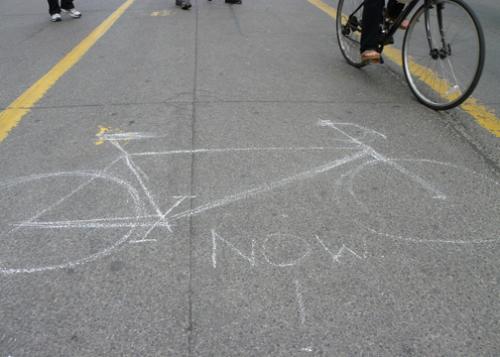
 BikeNow
Photo taken at the Streets Are For People street closure on John street April 20th.
tino : 17 years 12 months ago
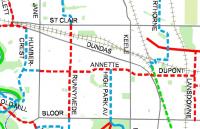 Bike Plan: Annette St. area
West end cyclists may want to attend tomorrow evening's public meeting about the Annette St. bike lane. 6:30pm at the Annette Recreation Centre. Details about the meeting are posted here.
I frequently ride along Annette St., especially the section between Dundas and Jane streets. It's actually a pretty decent east-west route through that part of the city, except for the fact that the pavement is in absolutely terrible condition. It's primarily a residential area, with some small shops, schools, and several churches along the way.
As part of this year's re-paving, it appears they will finally be putting in the bike lanes that have been promised in the Bike Plan for ages. Personally, I'd be happy enough if they just fixed the pavement and didn't put in any bad cycling facilities. But if they can put in something good (at the expense of parking) I'm all for it.
This lane would connect to the Runnymede bike lane (north-south), a southbound route to the waterfront via High Park Ave., the Humber River trail system via the Baby Point area, the West Toronto Rail Path, and also continue eastward along an eventual Dupont St. bike lane.
I'm not sure if there has been any community opposition to this bike lane, but it might be a good idea for cyclists to attend this meeting so that we can 1) find out more about the project, and 2) provide input so that it gets done in a bike-friendly way.
A few points that I think are worth bringing up at the meeting:
- It is essential that bike lanes are NOT built in the door-zones of parked cars. Parts of the Runnymede bike lane are completely unusable because of this.
- Make sure the bike lane at intersections does not create a right-hook situation for cyclists. The bike lane should remain wide, and the line dashed, to encourage motorists to merge properly before trying to turn.
- The excellent design and implementation of the eastern terminus at the Annette / Dundas / Dupont / Old Weston Rd. junction is critical. This collision of several busy roads can be tricky, even for experienced cyclists. Some specific points that should be done here are:
- Improve the lane markings and lane direction symbols on the roads. They have been almost completely worn off for some time now. It is not always obvious where cyclists and motorists should be positioned when traversing this intersection, especially when traveling between Annette and Dupont.
- Consider sharrows placed in the middle of the lane going under the Dupont St. railway underpasses. When it comes time to upgrade Dupont St., the actual lane configuration can be re-worked. (Yes, this is just outside of the current bike lane's implementation, but the connection is critical)
- Maybe this would be a good place to install a "bike box" and advanced green for cyclists so that we can easily take the lane?
- There can be a significant amount of right-turning traffic from Annette St. onto Dundas St. Make sure the bike lane doesn't dump cyclists into a right-hook zone.
- What about enforcement? The Runnymede bike lane almost always has cars parked in front of certain stores, and at Runnymede Station. What will be done to prevent the Annette St. bike lane from becoming a parking lot for the schools and businesses?
What do you think? Post your own ideas and suggestions here, and better yet, bring them to the meeting. If you can't come, please send your thoughts to bikeplan@toronto.ca and Ward 13 councillor Bill Saundercook councillor_saundercook@toronto.ca
vic : 18 years 4 hours ago
- 23 comments
A number of cities are experimenting with "public bikes" or "bike sharing". In Toronto we had our own experiment with CBN's Bikeshare. Last fall, Toronto's city council directed the Chief Planner to investigating a public bike scheme and to look into starting up a pilot project for staff.
Bikesharing started around 30 years ago, in Amsterdam by the Provo anarchist group with a free white bike scheme. Last year it hit big time with the launch of Vélib in Paris (short for Vélo Liberté or bike freedom). Now a number of cities are starting up their own and the place to read all about the different projects is on the Bike-sharing Blog.
On 15th July 2007, 10,000 bicycles were put on the streets of Paris as a new form of urban transport. The Vélib project is run by advertising firm JCDecaux in exchange for the revenue from advertising on billboards. (As of yet there are no completely self-funding bikesharing projects but the same argument could be made of public transit or even the publicly subsidized automobile industry.) JCDecaux and other advertising companies are now providing these "turnkey" operations to other cities. They are attractive for many cities since because the infrastructure and financing come together in a nice, handy package (though not necessarily the cheapest way to implement them).
The Vélib scheme was part of Paris' mayor Bertrand Delanoë's aim to reduce car traffic by 40% by 2020. From its launch last year analysts have found some interesting results:
Number of trips:
- In 6 months (July 15, 2007 - January 15, 2008) there have been 13.4 million trips or about 75,000 trips/day.
- Trips are highly weather-dependent. When the weather is cold and wet, Velib’ has 30,000 trips/day. When the weather is nice, Velib’ can have up to 140,000 trips/day.
- A large percentage of the overall trips are for commuting purposes.
- 25% of trips are from 9PM to 3AM. (Other transit modes run less frequently during these hours, so more reliance is placed on Velib'.)
- The average trip length is 20 minutes. This is about a 3-mile trip in an urban environment with traffic signals and stop signs.
- Only 8% of trips are greater than 30 minutes.
Number of subscriptions:
- 166,000 yearly subscriptions for $45 have been bought.
- In 6 months, about 205,000 tickets for weekly subscriptions for $7.50 and 2.5 million daily tickets for $1.50 have been bought. There is huge tourist demand.
Andrew Curran of TransLink provides a spreadsheet of potential mode share scenarios that Velib could create in Paris. In Andrew's scenario #1 where "Paris finishes installing all 20,600 public bikes, they will have more than doubled their cycling mode share in the span of a few months – increasing by 118% (from 1.63% to 3.55%)", assuming current usage. In addition to the increase in usage of public bikes, the number of private cycling trips will likely occur "since the public bicycle system acts as a 'door opener' to increase the acceptance of cycling as an urban transport mode."
I'd like to present a few different videos to give people an overview of the successes and problems with the Paris program and other similar projects. The embedded video by Bikes Belong features Eric Britton, Consultant for Sustainable Urban Transport. View at your leisure:
- Vélib in Paris
- Vélib Freeride. A bunch of yahoos do some really expensive Vélib freeriding (unless the bikes were stolen).
- Global News on Velib - mentions that Toronto's "transit boss" visited Paris to see what it was all about.
- Montreal's Municipal Bike Rental by Concordia TV. 2400 bikes, 300 service points for 6-7 months per year
herb : 18 years 1 day ago
- ‹ previous
- Page 331
- next ›