I went to the open house for the “Gardiner Expressway At Kipling Avenue And Islington Avenue Interchanges.” back on the evening of June 11.
My intent, goal and purpose in attending is to make sure that our city staff are thinking about keeping and encouraging the industrial activities in the area while also making sure they follow our city’s official plan, clean air strategy, transit city, bike plan, and pedestrian charter, all of which call for reduced car traffic and reduced car dependency while also encouraging active and public transit. In other words, I want improved safety for pedestrians and cyclists, continued truck access for the area's industrial lands, while not making it too easy for the cars.
After making my way into the building, I found the gymnasium and I signed in. I was very surprised to see more staff than attendees; perhaps it was just my timing. I was informed that the meeting had been well attended, however none of the staff looked at all haggard, all of them were smiling and in good spirits and eager to talk about the plans. The plans were up on easels outlining a rectangle area covering almost half of the gymnasium floor.
I started looking over the background information of the Class Environmental Assessment Study to understand what it was trying to achieve and why. I needed to earnestly understand the scope and nature of the problem that this was to resolve in order to make sure that any position that I could take on this would make sense in a larger context. I needed answers to questions such as
- Is this even necessary?
- Who will gain the largest benefits?
- What are the intended vs. the actual benefits?
- Will this be good for the city?
- Will this be good for the nearby communities?
- Will it improve pedestrian, cycling access over the bridges?
- Will it interfere with the truck movements associated with the businesses in the nearby industrial areas?
- Will it reduce conflicts with large and small vehicles?
- Will it interfere with, or improve, public transit in the area?
- Is this just a sneaky way of getting popular highway access improvements in under the radar in spite of the city’s Official Plan, Clean Air Strategy, Climate Change Plan, Transit City, Bike Plan, and pedestrian charter?
After I started looking around, and once I got some footing, I started asking Scott Mitchell, Engineer/Coordinator of Infrastructure Planning in the city's Transportation Services division, some pretty pointed questions about this, and about the expected results and impacts of the proposed changes. It didn’t take long at all until John Kelly, Manager of Infrastructure Planning, Transportation Services intervened (Where did he come from? I didn’t see him in the room when I entered) and he adeptly handled all of my subsequent questions. In fact we had a rather good discussion about this.
John Kelly’s response was that this study’s primary objective, and scope, was to improve safety. He went on to explain about the specific configurations, such as the "weaving", which are too tight to work well with the current traffic volumes. He also explained how these changes achieve the desirable end of improved safety, and how this included improved accommodations for pedestrians and for cyclists.
There are also other good reasons to bother with this kind of work, besides keeping a city department looking busy and employed. Reasons include wanting or needing to improve certain segments of our economy, attract certain industries to our community, or to stimulate a particular growth pattern. None of these other reasons apply, and anything but improved safety is outside the scope of the Environmental Assessment (EA).
One of the options, and not one to be followed up on, would be to reduce access by removing some of the on/off ramps. While this would also achieve the goal of improving safety, it would make truck access to the nearby industrial areas much more difficult and would have negative foreseeable impacts on the nearby communities, and to the city.
There are a lot of unknowns when doing something like this. But the scope of this reconfiguration is not large enough to warrant further in-depth studies and analysis to know which, if any, of the proposed plans would be best. Some collision analysis has taken place, but we largely have to go on gut instinct, business impacts, and budget, to make the best decision that we can.
At the street level, as the high speed ramps are being replaced with controlled intersections (traffic lights). This allows active transportation (walking, cycling, etc) to have an easier go through here. I'm disappointed that bike lanes are not included, however that's "out of scope" of the current EA.
In order to improve safety at the highway level, "weaving" needs to be eliminated; that is: a lane shouldn't be both a merge and diverge lane at the same time. Some acceleration lanes need to be lengthened.
My own feeling is that most of the "carried forward" plans achieve these goals, but some are marginally better than others. I'll let you make your own judgements.
For those who (want to) know about these things, this is being done as a “Schedule C, Municipal Class Environmental Assessment” which means the scope is limited; unlike the very broad scope of an Individual EA.. June 11 was the public meeting that occurs during Phase 2; the next public meeting will be during Phase 3 of the process.
Feedback for this is required by July 3.
Feedback should be sent to the following, but you can also post at least part of your feedback here for discussion as well:
Public Consultation Unit
City of Toronto
Metro Hall, 19th Floor
55 John Street
Toronto Ontario M5V 3C6
Tel: 416-397-7777
Toll Free: 1-800-465-4056
Fax: 416-392-2974
TTY: 416-397-0831
Email: works_consultation@toronto.ca

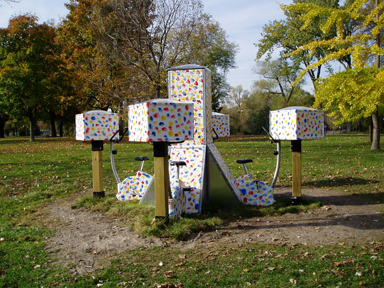 Synthecycletron