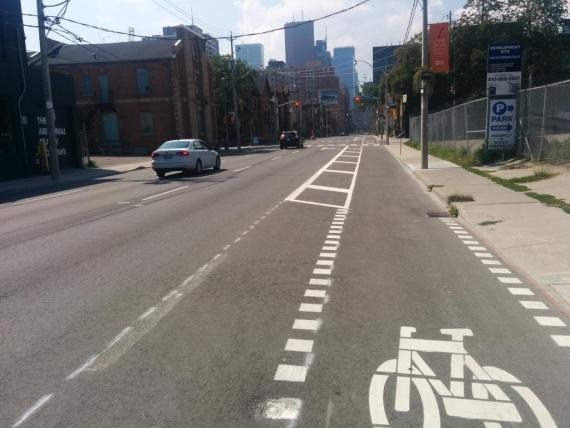
Richmond

Councillor Vaughan will not support "bicycle highways," in and of themselves, on Richmond and Adelaide

Dunsmuir cycle track - Paul Krueger

No matter which way you look at it, Councillor Vaughan has never said "I unreservedly support separated bike lanes on Richmond and Adelaide". Instead he has caveats and reservations. Vaughan is willing to sacrifice protected bike lanes, and the safety of cyclists, on Richmond and Adelaide if he doesn't get his beautification list. On their own, in and of themselves, protected bike lanes have little value to Vaughan. This much I have parsed from his words. (Photo: Dunsmuir bike lane. Credit: Paul Krueger.)

Councillor Vaughan told me he supports bike lanes. In an email, he replied "Separated bike lanes, integrated with a stronger pedestrian realm is a must." He was visiting Vancouver at the time, exclaiming "great bike lanes here!" But here's his qualifier: "If all we build is a bike lane then all we will have accomplished is building a by-pass." An "isolated gesture". Just "bicycle highways". So is that a maybe? Why is a well-informed politician, who has a strong opinion on almost every area of city building, caging his words on separated bike lanes?

By the way, Councillor McConnell didn't put any restrictions on her support for protected bike lanes on the portions of Richmond and Adelaide that run through her ward. She supports them. Period.

Isolated gestures

Vaughan celebrates Vancouver bike lanes, but does he know that the outstanding protected bike lanes on Dunsmuir and Hornby streets were done as "isolated gestures"? Mayor Gregor Robertson of Vancouver took leadership in pushing for them even against some local opposition. The primary focus was bike lanes. Sure they put in planters but they weren't deal breakers. For free, Vancouver got even further separation of car traffic from traffic on the foot highway (like in the photo above).

The protected bike lanes, in fact, would be an isolated but major gesture for a ward where little has been done to install and advance protected cycling infrastructure. Politicians and traffic planners alike have mostly ignored cycling safety for so long that in order to get anything built, bike lanes are, by nature, "isolated". It seems as if bike lanes in downtown are constantly being pushed off the table, whether it be Yorkville, in front of Union Station, John Street and now the Annex. In each case the politicians and traffic planners have figured that people on bikes will just have to fight it out with cars.

Vaughan had a perfect opportunity to get protected bike lanes in Ward 20 when he was a close ally of former Mayor David Miller. During this administration's 6 years not one protected bike lane was built. The closest we came was a failed vote on a protected bike lane for University. People tend to focus on Councillor Paula Fletcher's mistaken vote, but the Mayor wasn't even present for the vote. It wasn't important enough for the mayor.

What does he want
Vaughan has described protected bike lanes at various times as "bicycle highways", "single use and isolated gestures", "barricaded", "by-passes". So why is he holding up progress on bicycle infrastructure? What are these other things he wants? From his comments I've gathered these requirements: "Stronger pedestrian realm" aka fancier "foot highways." Planters. Bike parking. "Connectivity". Two-way streets. "Complete streets"

Foot highways? Last I looked there were foot highways on both sides of the street. And they're bidirectional!

Planters? Well here you go:

But is he going to try to block the bike lanes if he can't get planters?

Bike Parking? Nope. Is he seriously considering this a requirement for his support?

Connectivity? Done. It already connects with Beverley bike lanes and Sherbourne! And can be extended to Eastern bike lanes and to the Railpath. (Richmond and Adelaide are certainly more connected than Vaughan's preference for Wellington).

Two-way streets? Come on, you can do better. New York is full of one-way vibrant streets as "destinations".

Complete streets Sorry, Vaughan's definition sucks: "accommodate choice in as safe and as beautiful a way as possible". So far as I can tell, no jurisdiction that has a complete streets policy has put "beauty" on par with safety. No one's going to say they hate beauty but who would sacrifice safety for it? (Other than an artist). Instead, Toronto's City Planning says complete streets is the "safe and adequate accommodation, in all phases of project planning and development, of all users of the transportation system." Let's use their definition.

Fast forward to now
We have a plan to build awesome, connected protected bike lanes across downtown. There are zero alternatives. So far, Councillor Vaughan is unwilling to lend his support. Is he just trying to squeeze some concessions, or his he willing to let the plan die if he doesn't get his way?

We'll see. This bike lanes will represent, I think, a turning point. Either we'll begin down the bicycle highway towards emulating cities like Chicago, Vancouver and New York, or we'll hit a deep pothole and stall safe cycling in this city.

Footnotes: quoting Vaughan on bike lanes
For those interested in the history of Vaughan's quotes on bicycle highways, read on.

Last year (2012) at a joint ward meeting that I attended with Cycle Toronto's representing wards 19, 20, 27, and 28 Councillor Vaughan had suggested that he was against "bicycle highways":

"...to create a bike highway through the downtown is as serious a piece of bad planning as a car highway."

He had also said at that meeting that "creating a single use capacity will not solve the problem".

Also last year (2012) at a meeting organized by the Harbord Village Residents Association on bike lanes for Harbord Vaughan had said:

When we build bike lanes they must be separated. Painted lanes are good but aren't safe enough. My son, who bikes, needs the separation to be safe.

People in this neighbourhood cycle but they don't do it safely. We don't accept it for drivers, nor for pedestrians, but we accept lack of safety for cyclists. We need to change that.

And in January of this year (2013) Councillor Vaughan had said to the Toronto Star that he remained undecided regarding bike lanes on Richmond and Adelaide.

It’s crucial that any bike lanes on Richmond and Adelaide be considered in the larger context of pedestrian traffic, cars and transit, said Councillor Adam Vaughan (Trinity-Spadina). Although he’s willing to consider bike lanes, he hasn’t made up his mind. The entertainment district needs to be considered as a destination, not just a series of thoroughfares, he said.

In 2011 in a letter to his residents Vaughan had called them "barricaded bike lanes".

From Vaughan's response from last week:

We have set aside funding for streetscape improvements. Bike lanes, bike parking, plantings and connectivity are all important components of a good plan.

I support exploring these issues specifically, and separated bike lanes generally. They are a critical component of the future for the street. But they must form part of a comprehensive re-thinking of the streets and not just a single use and isolated gesture.

If all we build is a bike lane then all we will have accomplished is building a by-pass. This is not good planning nor will it serve riders well. It should never be about getting from a to b. It should be about building complete streets that accommodate choice in as safe and as beautiful a way as possible. ...

Why unidirectional cycle tracks will likely work better on Richmond and Adelaide

Richmond and Adelaide unidirectional bike lanes

If all goes well Richmond and Adelaide will have protected cycle tracks by the end of next year. We don't get many chances like this in Toronto where we missed our Bike Plan's targets by a wide margin. Bike lanes on Richmond and Adelaide are in the Bike Plan, which means it's been over twelve years!

There is some risk that we won't get them. Councillor Vaughan, for instance, still won't commit to supporting the bike lanes (I'll delve more into what Vaughan thinks in my next post) and who knows what will happen after the 2014 municipal election if the lanes are delayed. So I think it's imperative to build them efficiently, while still getting a result that is safer and cost-effective. As I'll argue below, I think it's justified for us to get nit-picky and traffic-planning geeky here. I think you should support unidirectional protected bike lanes as the best kind of protected bike lanes for this project.

First, let's get the definitions right. A unidirectional cycle track has one way bike traffic. Cycle tracks in New York are mostly unidirectional (the photo above shows a unidirectional cycle track as imagined on Richmond by Dave Meslin). Good examples of bidirectional bike traffic can be seen on the Martin Goodman Trail, or the cycle tracks in Montreal. On bidirectional cycle tracks or bike paths bike traffic goes in both directions.

One of the main things going for a bidirectional cycle track is that it doesn't require as much width and typically allows for more on-street parking to remain. Such might be the compromise on Harbord/Hoskin where the Cycling Unit staff prefer a bidirectional cycle track. Hoskin and Harbord are considered good candidates for bidirectional because there are few major intersections -- only Bathurst and Spadina -- unlike Richmond and Adelaide.

However, there are more reasons to consider unidirectional cycle tracks for Richmond and Adelaide as the preferred option:

  1. Makes it easier to extend the bike facilities west of Bathurst to Strachan and perhaps connecting to the West Toronto Railpath extension through the CAMH grounds to Sudbury.
  2. Is less expensive because it doesn't require new traffic lights. Thus less likely to be shelved because of cost.
  3. Results in less waiting at intersections for all traffic because there would be fewer light phases.
  4. Is generally the preferred, safer option where it is possible to install unidirectional (according to traffic experts in Denmark and Netherlands).
  5. Makes it more likely that the bike lanes are installed before the election. We don't know if a new Council will still have the willpower to install them.
  6. Allows for more predictable traffic movements at major intersections, of which Richmond and Adelaide have a few (Bathurst, Spadina, University, Bay, Yonge, Church and Jarvis).

Danish researchers Ekman and Kronborg found that unidirectional tracks were typically safer than bidirectional because they allow for merging of traffic at intersections:

Ekman and Kronborg (1995) conducted an extensive literature review and interviewed bicycle safety and traffic-engineering experts across Scandinavia and in the Netherlands to compare the merits of unidirectional versus bidirectional bicycle tracks. They found that bidirectional tracks on one side of the road are cheaper to build than two unidirectional paths on opposite sides of the road but that the former are less safe. Bidirectional paths are less safe, they argued, because they do not allow cyclists to merge with traffic lanes when near intersections. Merging with traffic lanes reduces the risk of being struck by turning vehicles. [Ekman, L. & Kronborg, P. (1995). Traffic safety for pedestrians and cyclists at signal-controlled intersections. Report 1995: 4E. TFK. Lund.]

Note that they say that bidirectional is cheaper than unidirectional but they are assuming both options are on the same street. We have a unique opportunity to build on separate streets with unidirectional which would likely preclude installing whole new traffic signals. Thus believe unidirectional would be cheaper for Richmond and Adelaide. I'm interested to see if the EA will confirm that.

We've waited long enough
I think there's a recognition by many people that we've been waiting too long for good cycling infrastructure. As of this writing the groups who've officially supported the protected bike lanes, with many also specifying unidirectional, include Hot Docs, MEC, Annex Residents Association, Moore Park Residents Association, Liberty Village Residents Association, and West Queen West BIA. See the letters of support on Cycle Toronto's site.

Transportation Commissioner Gabe Klein of Chicago, noted at a recent talk in Toronto, that Toronto has gotten a lot of things right - streetcars, sidewalks, condos sprouting up all over. But the one glaring hole is a lack of cycling infrastructure. Toronto is exceptional among North American cities in that it has a significant cycling population but it has fallen way behind in providing protected bike lanes. While Chicago zooms ahead in installing hundreds of miles of protected bike lanes, cycling activists in Toronto are struggling to get just one cycle track that was promised years ago. So it's no wonder people are getting impatient.

Vaughan hasn't made up his mind yet on bike lanes for Richmond and Adelaide, even after 12 years in the Bike Plan

Councillor Adam Vaughan told the press yesterday, in regards to the news that the Environmental Assessment on Richmond and Adelaide bike lanes will be starting, that he is willing to consider bike lanes but that "he hasn’t made up his mind. The entertainment district needs to be considered as a destination, not just a series of thoroughfares". (Thanks to Tino for photo of Sherbourne.)

Vaughan hasn't made up his mind yet? Bike lanes are "thoroughfares"?! Bike lanes for Richmond and Adelaide have been in the City's Bike Plan for 12 years (some say it came up even earlier). Let's take a look back over the last 12 years.

2001 Bike lanes are proposed for Richmond and Adelaide in the Bike Plan (appendix, map).

2001 Bike Plan makes a promise that "All Toronto residents will be within a five minute bicycle ride to the bikeway network." The Bike Plan plans a grid of bike routes throughout the entire city. Even then there are gaps, even downtown. Progress is slow right from the start.

2001-present A smattering of bike lanes are built (and some stopped and some removed), most of them in the suburbs where roads are wider and don't require taking out car lanes.

2009 Councillor Kyle Rae declares Bloor at Yorkville a "destination" and didn't think bike lanes were "appropriate" (in his speech supporting bike lanes on Jarvis). The sidewalks are expanded and no bike lanes planned nor installed, despite protest from cycling advocates.

2009 A Ward 20 Cycling Committee is formed with the help of Councillor Vaughan's office. Many of the committee members eventually leave because of Vaughan's reportedly heavy-handed involvement but not before producing a report (see below).

2010 The City's Cycling Unit holds packed public meeting on the Bike Plan of over 200 people in February in Metro Hall. Dan Egan, manager of the Cycling Unit, outlines their priorities for the downtown bikeway network for 2010-2011. He mentions staff will advance Richmond and Adelaide bike lanes in their spring report to Public Works and Infrastructure Committee. The March report mentions nothing about bike lanes on Richmond and Adelaide. It's not clear why not? As a Miller-controlled committee, PWIC could have pushed for bike lanes on Richmond and Adelaide. It often happens that staff won't propose something if they know a local councillor is opposed.

2010 The Ward 20 Cycling Committee goes "rogue" and produces a report requesting protected bike lanes on Harbord, University and Richmond/Adelaide.

2010 Rob Ford wins election that fall.

2010 Councillor Denzil Minnan-Wong proposes cycle tracks for downtown, including Richmond/Adelaide.

2011 Vaughan sends letter to residents condemning "barricaded" bike lanes and accusing the Bike Union of not working with the local "community". Through a Vaughan initiated process the community didn't identify any east-west street through the city's core. It's not clear how Vaughan defines "community" but presumably it doesn't include people who commute to work in the area or who have to travel through the ward.

2011 Vaughan won't consider bike lanes on the well-used bike corridor, John Street, because he says it is meant to be a destination and not a transportation corridor (much as he's saying now about Richmond and Adelaide). Vaughan doesn't advance request to make alternative route on Peter/Soho safer crossing at Queen St.

2012 City Council approves an Environmental Assessment for Richmond and Adelaide.

2012 At the Harbord Village Residents Association meeting on bike lanes, Vaughan says to the group "Now when we build bike lanes they must be separated. Painted lanes are good but they aren't safe enough. My son needs something safer than just painted bike lanes." And he also says "People in this neighbourhood [Harbord] cycle but they can't do it safely. We don't accept such unsafe conditions for drivers, nor for pedestrians, but we accept it for cyclists. We need to change that."

2013 Richmond and Adelaide EA begins.

If Vaughan sees the big benefit of cycle tracks for the safety of cyclists, why hasn't he yet supported cycle tracks on Richmond and Adelaide? They were in the plan since 2001 and Vaughan was a major powerbroker when Miller was mayor. Richmond and Adelaide weren't brought to PWIC during that whole time.

And if Vaughan thinks Richmond and Adelaide aren't appropriate for bike lanes, then where? Richmond and Adelaide are nicely situated between two cycling corridors, King and Queen, but don't have the major drawback of streetcar tracks. The staff creating the Bike Plan were unable to find any other streets south of College that were useful for bike lanes.

Toronto seems to have a quite particular opposition to bike lanes by some progressives. The codeword is "destination", and it's been applied to a major arterial such as Bloor and now Richmond and Adelaide as a reason for not installing bike lanes. It's as if somehow the arterial road will cease to being a major street and turn into a residential street.

Vaughan says he supports cycle tracks. When will Vaughan make up his mind about Richmond and Adelaide?

Syndicate content
pennyfarthing ok frye